Let us explain the GADV-Microsphere Hypothesis!
Just as GADV amino acids were produced and accumulated in large quantities on the primitive Earth, it is thought that GADV microspheres were also easily formed by GADV proteins undergoing repeated wet-dry cycles in the hollows of seaside rocks.
Dr. Ikehara has the following suggestions regarding [GADV]-Microsphere.
”GADV-microspheres were the first protocells (Oba et al.2005). Of course, the GADV-protenoid membrane might contain amphiphiles from the very beginning, such as fatty acids and lipids, which were synthesized by prebiotic means and accumulated around the microsphere, although such amphiphiles could only play an auxiliary role in the membrane. Thus, GADV-protein world would be formed in the GADV-microsphere and various kinds of metabolic reactions could be carried out with immature GADV-proteins in the microsphere.”
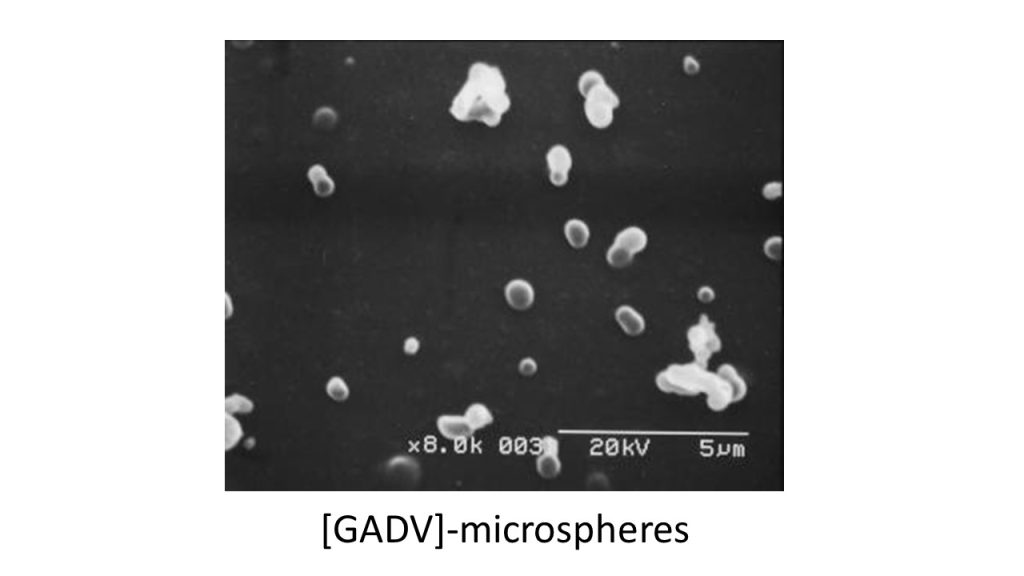
Source: Towards Revealing the Origin of Life, P.67, Fig. 4.4 (B)
*Scanning electron microscope image of [GADV]-protenoid microspheres, which were produced by repeated wet-drying processes of [GADV]-amino acids (Oba et al.2005)
GADV proteins were synthesized by pseudo-replication of GADV protein in the microsphere. This could then, increase the internal osmotic pressure to induce the growth and division of the microsphere.
Dr. Ikehara describes this phenomenon below.
“It can be considered that the first cell structure was not formed toward a predetermined purpose, but was accidentally formed, simply resulting in the emergence of life, although it can also be considered that the way to the formation of GADV-microsphere was prepared by something in advance.”
Synthesis of GADV-amino acids and nucleotides in GADV-microspheres
It is thought that various low-molecular-weight organic compounds such as glyoxylic acid (Go), glyceraldehyde (Ga), and pyruvic acid (Pyr) were synthesized in large quantities on the primitive Earth.
It is possible that they were incorporated into the newly formed GADV-proteinoid microspheres after the division of the proto-cell.
After that, it is thought that GADV amino acids and nucleotides were synthesized using the three glyoxylic acid (Go), glyceraldehyde (Ga), and pyruvic acid (Pyr) organic compounds as substrates.
It is thought that within the protocell, a basic metabolic system is formed that can synthesize various organic compounds and macromolecules such as GADV peptides using proteinaceous catalysts.
Protocells or microspheres also need to have the ability to divide independently.
Dr. Ikehara describes the ability to divide as follows.
“It is considered that the driving force of cell division of extant unicellular microorganisms is a high internal osmotic pressure, which is caused by the accumulation of biopolymers such as proteins inside the cell. Therefore, the protocell could divide and proliferated, if a low molecular weight organic compounds such as glyoxylate and pyruvate were incorporated into the protocell and polymers as GADV-peptides could be constantly produced in the protocell using GADV-amino acids as substrates.”
GADV-amino acids can be synthesized by the reaction of amination glyoxylic acid and pyruvic acid in the protocell.
Low-molecular-weight organic compounds such as glyoxylic acid and pyruvic acid may be passively taken up by the protocell due to the increase in internal osmotic pressure caused by the accumulation of GADV peptides. This reaction cycle is thought to have been a simple physical and chemical phenomenon.
Dr. Ikehara explains evolution of the [GADV]-microsphere without gene as follows.
“It is necessary to raise catalytic activities in the protocell without a genetic system as a whole in order to evolve step by step as propagating catalytic activities of a parental protocell to progenies during every division of the microspheres. (To enable step-by-step evolution, it is essential to enhance catalytic activities in the protocell without relying on a genetic system. This ensures that the catalytic functions of a parental protocell are passed down to its progeny during each microsphere division.) Many people may consider that it would be impossible for the microspheres to divide and proliferate. However, the pluripotency of immature GADV-proteins would make it possible for the microspheres to do so without any genetic system. The reason is because many catalytic activities of parental microspheres could be transferred to progeny microspheres because of the sufficiently high ability of pseudo-replication of immature but pluripotent GADV-proteins and a large amount of GADV-peptides accumulated in the parental microspheres.”
Reference: Ikehara K(2021) Towards Revealing the Origin of Life. Springer Nature