Genetic information (gene) codes for an amino acid sequence, which is necessary to synthesize a mature protein. Could such a gene be first created among the three members of the core life system-, : gene, tRNA (genetic code) and protein? It would be impossible to create genetic information for protein synthesis independently of proteins, because information itself could not be generated without a concrete object. These indicate that the first gene must be created after proteins and tRNAs were formed.
Let us discuss how the first gene (genetic information) was created!
There are two sides to the origin of genes. The first one (the origin of gene-Ⅰ) is to understand the way how the first gene was created through random processes on the primitive Earth. The second one (the origin of gene-Ⅱ) is to clarify the way how an entirely new (EntNew) gene or the first gene of a gene family was created.
Dr. Ikehara describes the following two hypotheses to explain the origins of the two genes (gene-Ⅰ and gene-Ⅱ) above.
“I present two of my own ideas here to explain the origin of gene-Ⅰ “. One for how was the first gene created?”-; the anticodon joining hypothesis; and another to explain the origin of gene-Ⅱ “, the pan-GC-NSF(a) hypothesis.”
Anticodon joining hypothesis
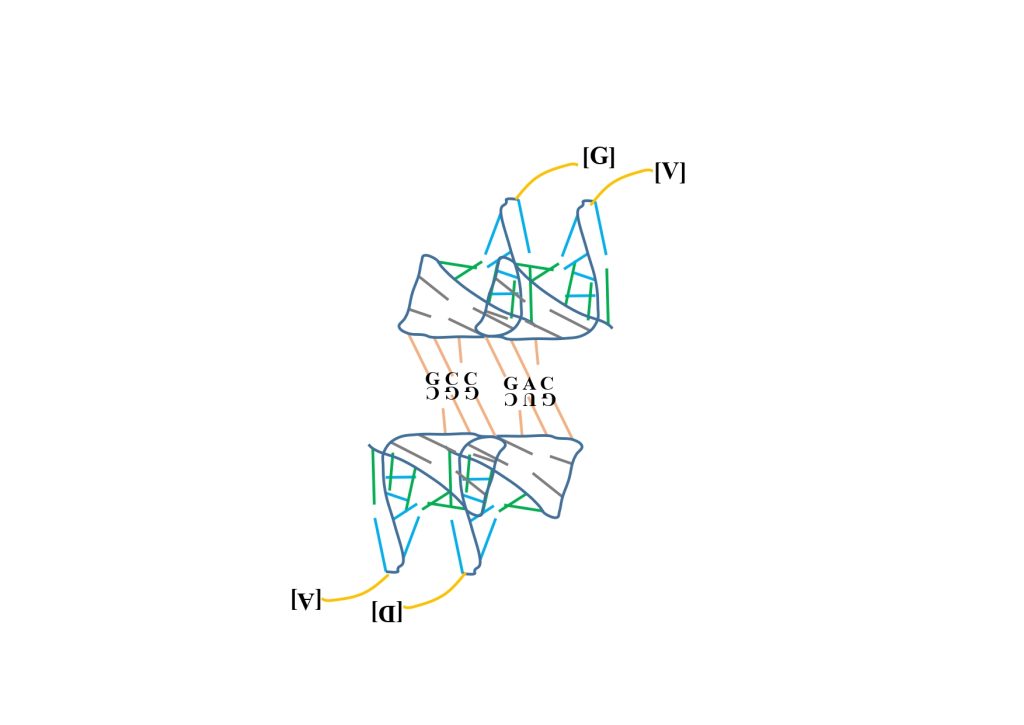
Source: Towards Revealing the Origin of Life, P.171, Fig. 8.3
*Formation of two dimers (as a whole, a tetramer), which were composed of two AntiC-SL tRNAs bound vertically through base pairs between two anticodons. The tetramer formation of AntiC-SL tRNAs made it possible to create the first genetic information. Because two anticodons could be positioned side by side to form a phosphodiester bond between the two them for the first time. The AntiC-SL was drawn by tracing the AntiC-SL of modern Yeast Phe-tRNA (PDBj,(1EHZ))
Pan-GC-NSF(a)Hypothesis
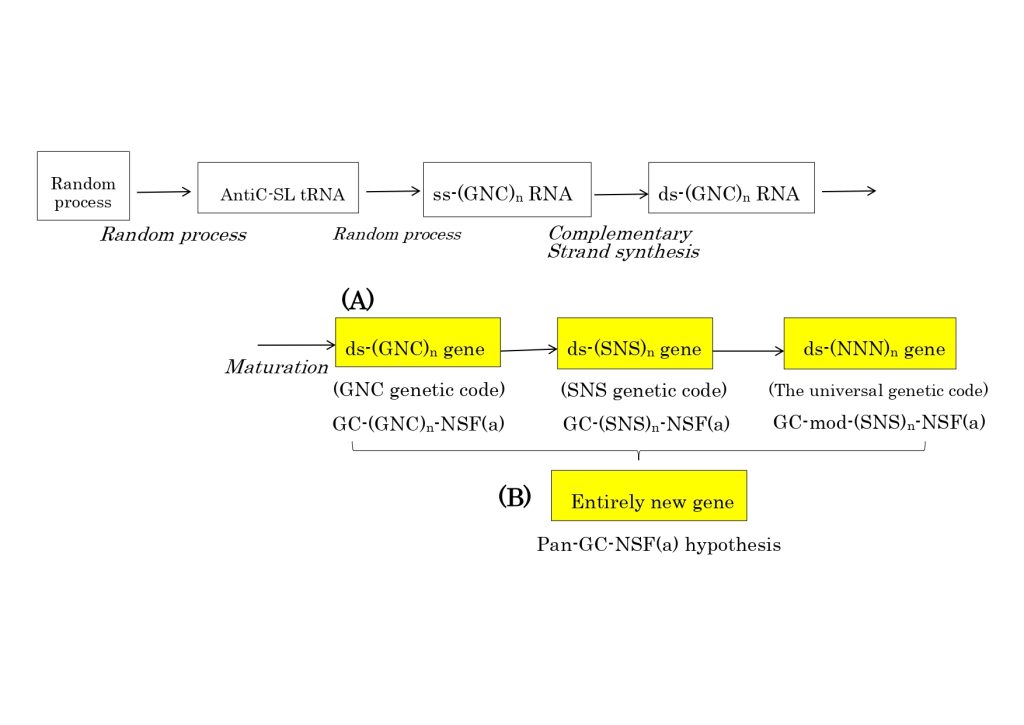
Source: Towards Revealing the Origin of Life, P.185, Fig. 8.9
*The origin and evolutionary process of genes. (A) The creation process of the first ds-(GNC)n gene encoding a mature [GADV]-protein. Acquisition of AntiC-SL tRNA triggered the formation of the first ds-(GNC)n RNA gene, as suggested by the AntiC-SL tRNA hypothesis. (B) Creation mechanism of entirely new genes. The mechanism is fundamentally the same among the three genetic code eras, because entirely new genes could be created from the respective nonstop frames on antisense strands (NSF(a)) of the corresponding GC-rich genes or GC-(GNC)n-NSF(a), GC-(SNS)n-NSF(a) and GC-NSF(a), which is a modified GC-(SNS)n-NSF(a) sequence (GC-NSF(a)=GC-mod-(SNS)n-NSF(a)), as expected by pan-GC-NSF(a)hypothesis. The hypothesis indicates that entire genes were and have been created through essentially random processes.
Next, let Us explain at the process of protein maturation.
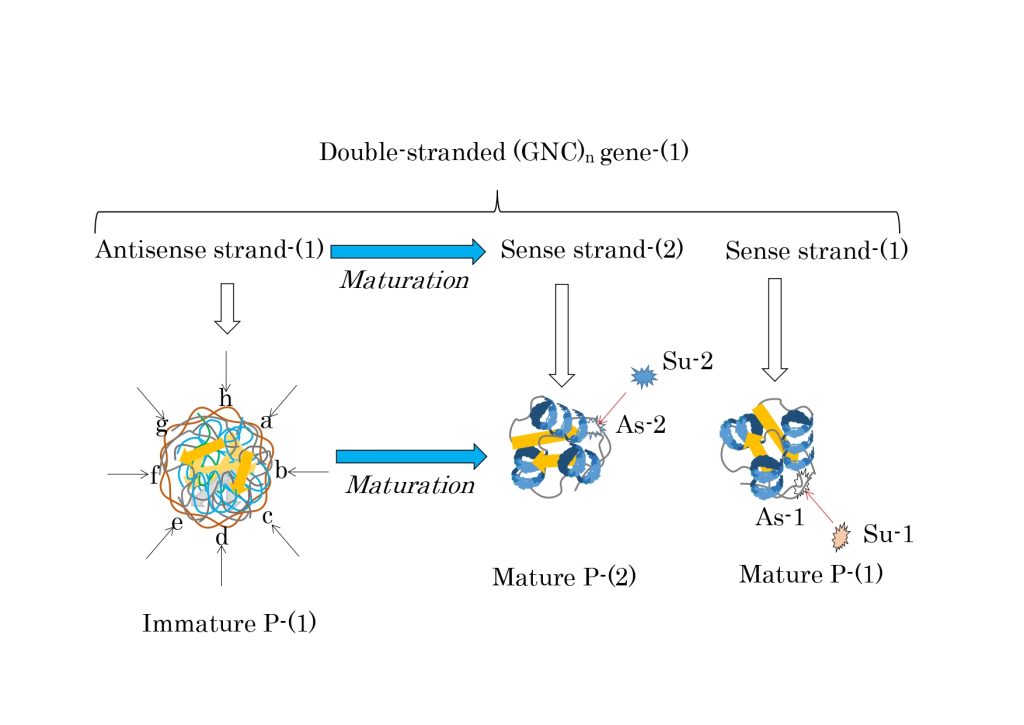
Source: Towards Revealing the Origin of Life, P.176, Fig. 8.6
*Creation of a new mature P-(2) from an immature P-(1), which was produced from an antisense strand-(1) of GC-rich (GNC)n RNA gene-(1). The memorizing ability of base substitutions of the ds-RNA made it possible to evolve the immature P-(1) to a mature P-(2) with a rigid and compact structure, by raising the function of the active site (As) for the substrate (Su) and, in parallel, by excluding other unnecessary catalytic activities. Numerals (1) and (2) indicate the first and the second generations for formation of the mature gene/protein, respectively.
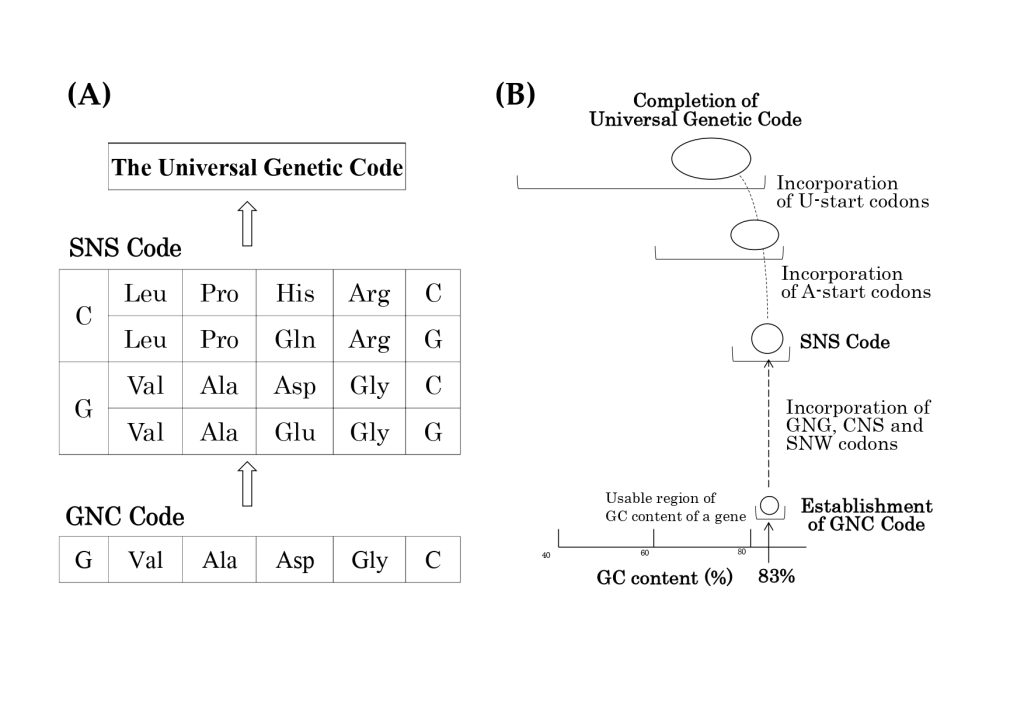
Source: Towards Revealing the Origin of Life, P.189, Fig. 8.10
*(A) Evolutionary pathway of the genetic code. The evolutionary process is drawn according to GNC-SNS primitive genetic code hypothesis, assuming that the modern genetic code originated from GNC code encoding four [GADV]-amino acids (Ikehara et al.2002). (B) Change of the field for entirely new gene creation, accompanied by the genetic code evolution. After establishment of GNC code, new codons were incorporated into the GNC-code in order of GNG, CNS, GNW, CNW, A-start and U-start codons(Ikehara 2019). Upon the evolution of the genetic code, the field for entirely new gene creation shifted from extremely GC-rich(around 83%) to ordinary GC-rich region around 60 to 70%. Circles and ellipsoids indicate the supposed fields for entirely new gene creation. Upward brackets show the supposed usable region of GC content of a gene under the respective genetic codes.
Reference: Ikehara K(2021) Towards Revealing the Origin of Life. Springer Nature