Let us think about the process of establishing primitive metabolism.
We think that the following five conditions must be satisfied to establish the most primitive metabolism.
(1) The first metabolism must be constructed by a random process.
(2) Chemical reactions carried out in the initial metabolism must be catalyzed by proteins produced by random process in the absence of gene even though they may be immature and incomplete.
(3) Organic compounds that were easily synthesized by prebiotic means and accumulated in large quantities on the primitive Earth should be used as reactants in the initial metabolism.
(4) Organic compounds produced in the initial metabolism must be useful for the emergence of first life.
(5) Catalytic reactions proceeding at reaction steps as less as possible would be favorable for the initial metabolism.
Dr. Ikehara has the following opinions based on his analysis of the latest metabolic reactions under the above five conditions.
“Based on the analyses of modern metabolic reactions under the five conditions, three organic compounds, glyoxylate (Go), glyceraldehyde(Ga) and pyruvate(Pyr)(GoGaPyr) were selected out as reactants of immature GADV-proteins, which were then produced by random joining of GADV-amino acids. The reasons are that the three GoGaPyr compounds composed of two or three carbon atoms could be easily synthesized by prebiotic means and should have accumulated in large amounts on the primitive Earth. Another reason would be the supposition that the two organic compounds, glyoxylate and pyruvate, lead to the synthesis of four GADV-amino acid (Gly[G], Ala[A], Asp[D], and Val[V]) . Glyceraldehyde is a precursor molecule for synthesis of ribose 5-posphate, which is necessary for the production of nucleotides and RNA.”
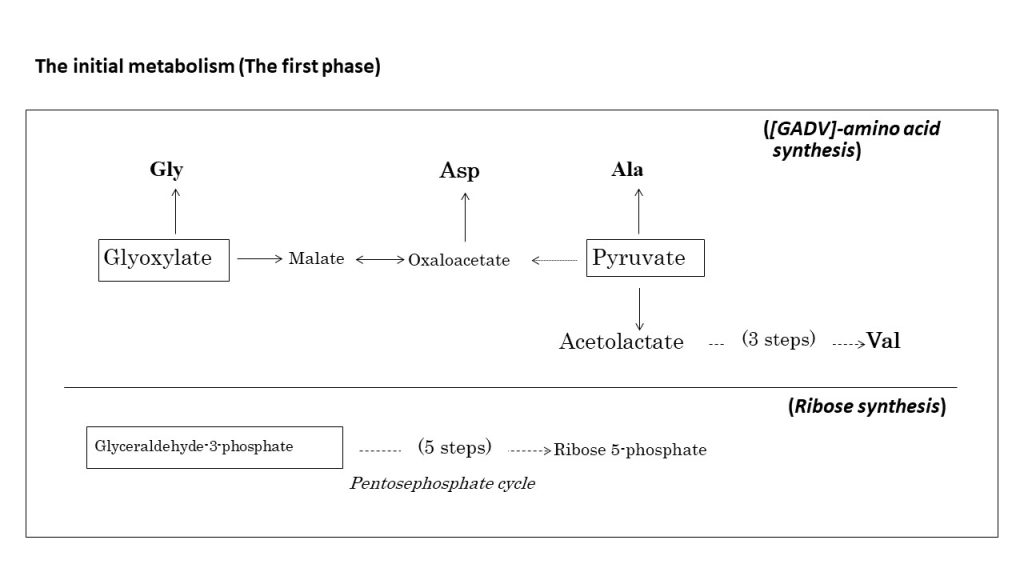
Source: Towards Revealing the Origin of Life, P.94, Fig. 5.7
*Solid arrows indicate that the reactions proceed in one step. Dotted arrows and broken arrows show the reaction steps that are harder to go through and metabolic reactions proceeding in multi-steps, respectively.
*The initial metabolism(the first phase) deduced based on the conditions for the initial metabolism.
(1) Gly is produced by amination of glyoxylate in one reaction step.
(2) Ala is also produced by amination of pyruvate in one step.
(3) Asp is synthesized from glyoxylate in a three-step reaction through malate and oxaloacetate.
(4) Val is synthesized from pyruvate in four reaction steps through acetolactate.
Thus, synthetic pathways of [GADV]-amino acids were established to form the first phase of the initial metabolism.
Ribose 5-phosphate synthesis from glyceraldehyde 3-phosphate is also included in the first phase of the initial metabolism.
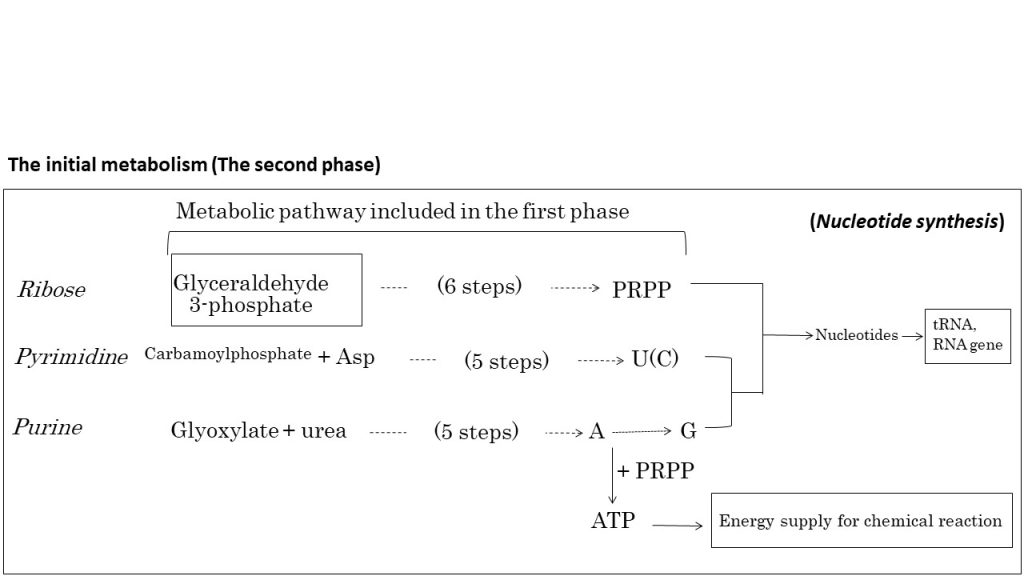
Source: Towards Revealing the Origin of Life, P.95, Fig. 5.8
*The initial metabolism (the second phase), in which nucleotides and RNA were produced. The second phase is composed of three synthetic pathway;
(1) pyrimidine base (uracil(U) and cytosine(C)) synthetic pathway in five reaction steps, which start from the addition of carbamoly-phosphate to Asp.
(2) It is supposed that adenine (A), which was produced from glyoxylate and urea through reverse salvage pathway, was used for ATP synthesis. Thus, RNA synthesis became possible after the second phase of the initial metabolism was established. ATP synthesized with adenine and PRPP(Phosphoribosyl-pyrophosphate) was used to accelerate various chemical reactions. PRPP synthetic pathway from glyceraldehyde 3-phosphate(the first phase) is also included in this figure, because the pathway was used for nucleotide synthesis.
Source: Towards Revealing the Origin of Life, P.96, Table 5.3
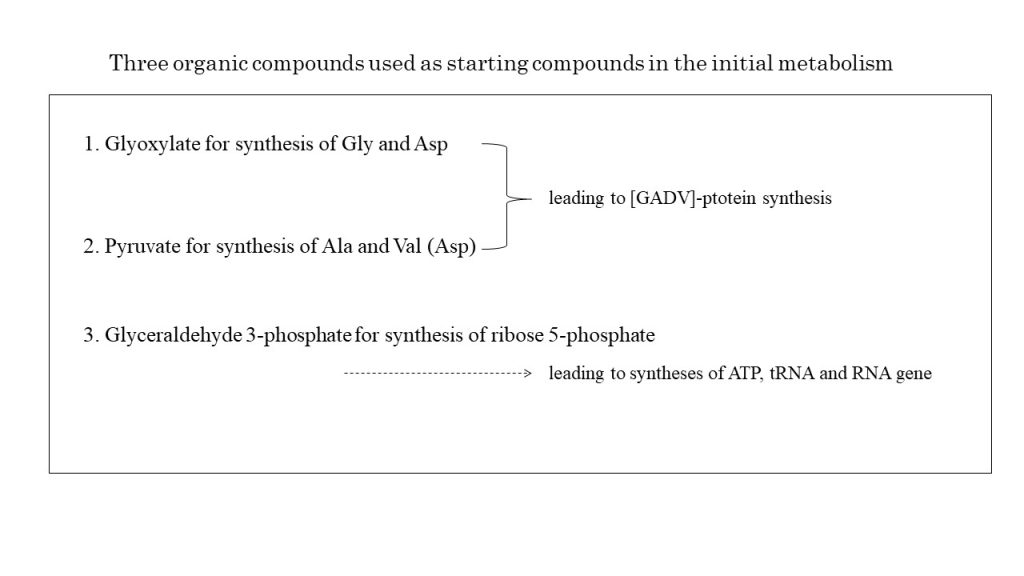
Three organic compounds used as starting compounds in the initial metabolism.
Dr. Ikehara proposes the new idea on the origin of metabolism as follows.
The “GoGaPyr (three compounds) hypothesis”, assumes that modern metabolism originated from three simple organic compounds : glyoxylate, glyceraldehyde and pyruvate. The origin of metabolism proposed in GoGaPyr (three compounds) hypothesis is compatible with the idea that life emerged according not through the “gene/replicator-first” theory, but through the “protein/metabolism-first” theory of the origin of life.”
Reference: Ikehara K(2021) Towards Revealing the Origin of Life. Springer Nature